

Dysgraphia in childrenwhen writing is unusually hard.
Some children work hard at handwriting and still find it slow, tiring and hard to read. Dysgraphia is a learning disability that affects handwriting, spelling and getting ideas onto paper. It has nothing to do with how clever a child is, and with the right help, writing can get much easier.
A guide for parents and teachers. This page is general information, not a diagnosis: if you are worried, talk to your child’s teacher, an occupational therapist or your doctor. Updated 27 November 2026.
What is dysgraphia?
Writing by hand takes many skills at once: forming letters, spacing them, spelling words, and keeping the sentence in mind. For most children, letter formation becomes automatic after a few years, so their attention is free for spelling and ideas. For children with dysgraphia, it does not become automatic in the same way. Writing keeps taking a lot of effort.
Experts often describe two sides, and a child can have one or both:
- The motor side: forming letters, pencil grip, size, spacing and speed. Handwriting is hard to read and tiring.
- The language side: spelling, and turning ideas into written sentences. A child may talk well but write very little.
Dysgraphia can occur on its own or together with dyslexia, ADHD or developmental coordination disorder (DCD, also called dyspraxia).
Signs of dysgraphia by age
Every young child writes messily at first, and children learn at different speeds. One sign on its own means little. What matters is a pattern that stays, compared with classmates, despite good teaching and regular practice.
Pre-K and kindergarten
- Avoids drawing, colouring and writing much more than other children.
- Holds the crayon or pencil in an awkward or very tight grip.
- Finds it hard to copy simple lines, shapes and letters, even after a lot of practice.
Grades 1–3
- Handwriting is hard to read: letters of mixed size and slant, uneven spacing, letters not on the line.
- Forms letters in a different way each time, or starts them in unusual places.
- Writes very slowly, or gets tired, cramped or sore hands quickly.
- Spelling is much weaker than reading, or the same word is spelled differently on one page.
- Copying from the board takes a long time.
Older children
- Can explain ideas well out loud but writes far less, or far simpler, on paper.
- Writing still takes a lot of effort, so there is little attention left for ideas, spelling and punctuation.
- Avoids writing tasks, or becomes upset by them.
What causes dysgraphia?
The exact causes are not fully known. Research points to two things: difficulty holding the shapes of letters and written words in working memory (orthographic coding), and difficulty planning a series of finger movements. It is not caused by laziness, poor parenting or low intelligence, and children with dysgraphia are not “not trying”. Learning disabilities often run in families.
When to get help
Talk to your child’s teacher if, despite regular practice, writing stays much slower, harder to read or more tiring than for classmates, if it hurts, or if your child starts avoiding writing or getting upset by it. In the US you can ask the school for a free evaluation.
- An occupational therapist (OT) assesses the motor side: grip, letter formation, fine motor skills and speed.
- A psychologist or neuropsychologist assesses spelling, language and written expression, and checks for dyslexia or ADHD.
- Your doctor can rule out other causes, such as problems with vision or muscle tone.
Extra help does not need to wait for a diagnosis. The strategies below are useful for any child who finds writing hard.
What helps children with dysgraphia
Explicit teaching of letter formation
Show how each letter is formed, with a fixed start point and stroke order, a few letters at a time. Say the strokes aloud. Practise until the letter is automatic, then review often.
Short, frequent practice
Five to ten minutes a day works better than a long session. Stop before the hand gets tired.
Paper that helps
Bold lines, a shaded middle zone, raised lines, graph paper or one letter per box make size and spacing easier to see.
Separate ideas from handwriting
Let the child say the sentence first, or tell it to you, then write it. Or let them type or dictate the ideas and handwrite only a short part.
Accommodations at school
More time, less copying (a printed copy of the board work), shorter written answers, typing or speech-to-text, and oral answers where writing is not the point of the task.
Typing as well as handwriting
Typing uses different movements and is often easier. Learning to type is a skill too, so it helps to start early. Typing does not replace teaching handwriting.
Spelling instruction
If spelling is weak, explicit teaching of sound–letter links and spelling patterns helps writing too.
Just as important: praise effort and ideas, not neatness. Children with dysgraphia often work much harder than it looks. Let them show what they know in other ways too.
Free dysgraphia worksheets
Bold-line paper, one letter per box, letters by family with start dots, short rows with rests and keyboard practice. All of them are in the free dysgraphia handwriting pack.
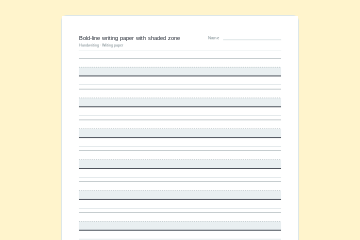 Free Printable Handwriting Paper: Bold-line writing paper with shaded zone
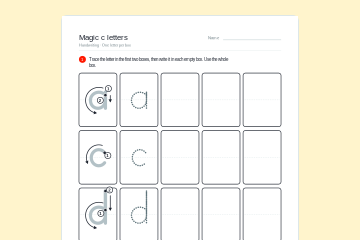 One Letter per Box Worksheet: Magic c letters
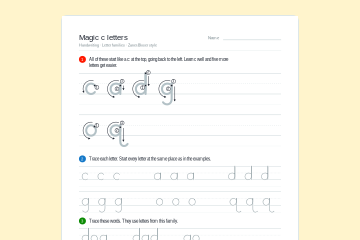 Magic c letters Worksheet
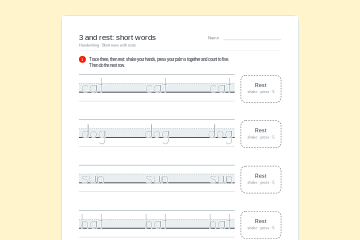 3-and-Rest Handwriting Sheet: Short words
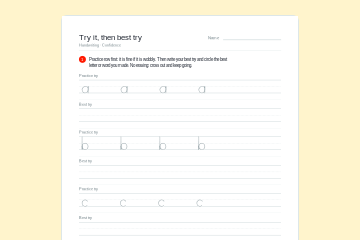 Try It, Then Best Try Worksheet 1 (No Erasing)
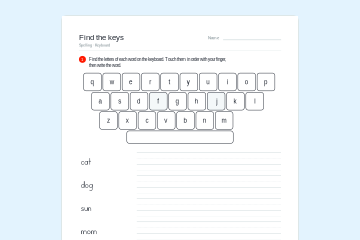 Keyboard Letters Worksheet 1: Find the Keys
Related packs: DCD (dyspraxia) and handwriting · Slow handwriting · Tired hands when writing · all packs
Practising letter formation with LetterSchool
The LetterSchool app shows the start point and stroke order of every letter and gives feedback on each stroke, in short game-like sessions. Occupational therapists and teachers use it alongside their own teaching. It does not diagnose or treat dysgraphia, and it is not a replacement for an assessment or therapy.